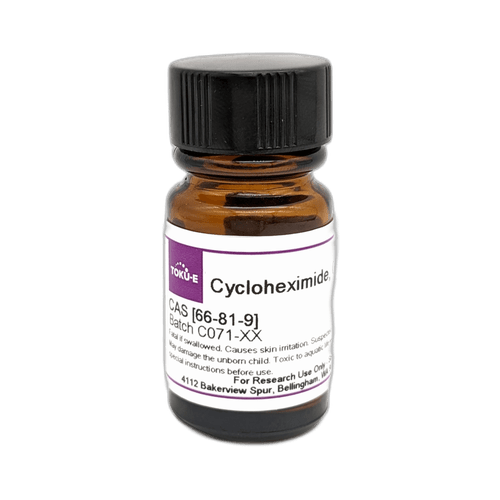

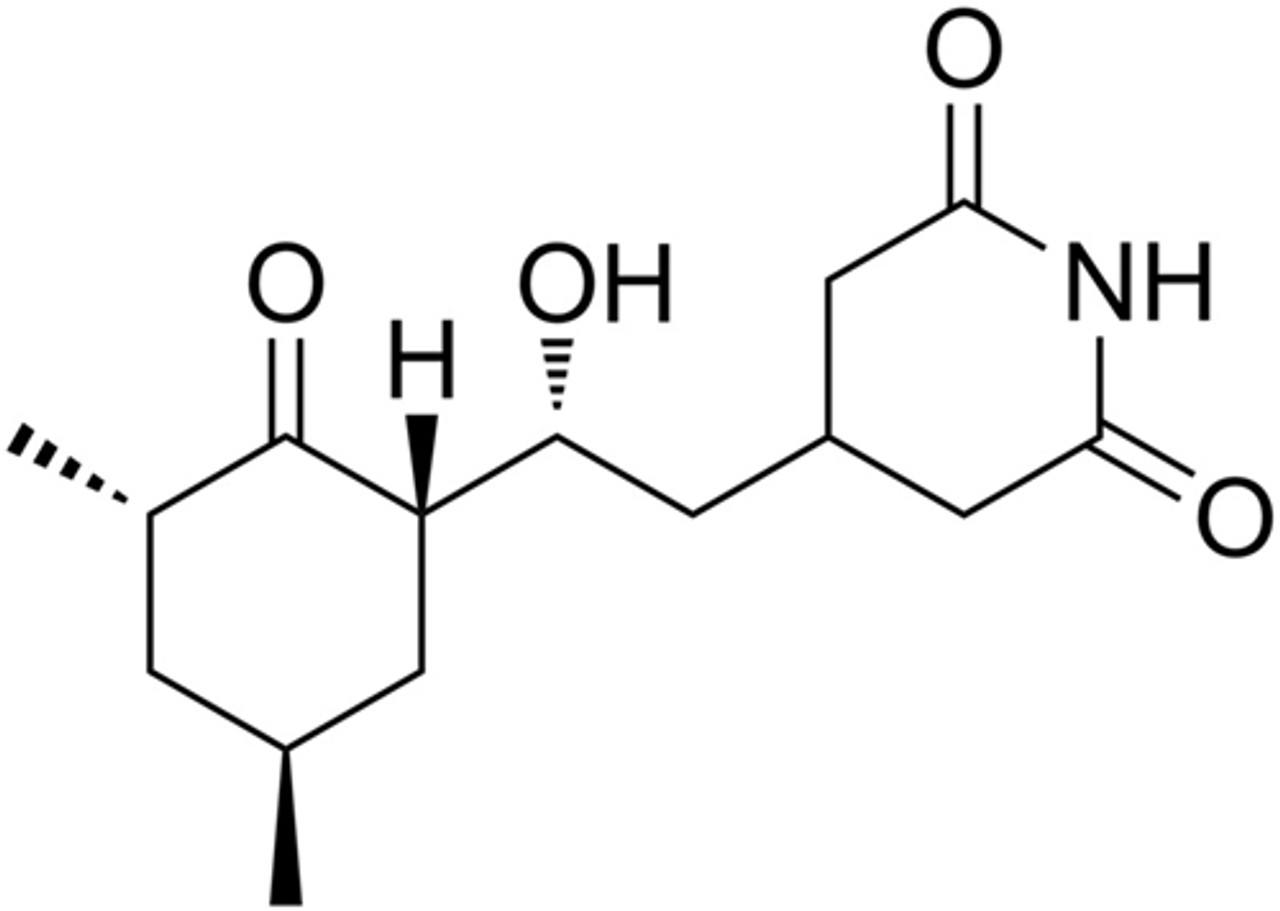
Cycloheximide is a glutarimide antibiotic and natural fungicide isolated from Streptomyces griseus and a protein synthesis inhibitor in eukaryotic cells. It was discovered by Alma Whiffen-Barksdale of Upjohn Company in 1946. Cycloheximide is routinely used as a selection agent in several types of isolation media. In molecular biology, it can be used as an experimental tool to determine the half-life of a protein or to study protein synthesis and degradation. Cycloheximide can also be used in protein expression studies, translational profiling and ribosome profiling.
Cycloheximide is soluble in DMSO and ethanol.
This product is considered a dangerous good. Quantities above 1 g may be subject to additional shipping fees. Please contact us for details.
We also offer:
- Cycloheximide Solution (10% in DMSO, Sterile)(C084)
- Cycloheximide, CulturePure (C071)
- Cycloheximide A, EvoPure (C123)
- Cycloheximide ReadyMade Solution (C084)
| Application | Cycloheximide is used in molecular biology for ribosome profiling/translational profiling to understand the complexity of translation initiation. Cycloheximide is used to study protein synthesis, expression and degradation, and determine the half-life of proteins. |
| Mechanism of Action | Cycloheximide binds to the ribosome and inhibits the eEF2-mediated translocation step in protein synthesis, thus blocking translational elongation. |
| Spectrum | Cycloheximide is used for fungi and yeast, including fungi found in brewing test media. It has lower activity against bacteria. |
| Microbiology Applications | Cycoloheximide is routinely used as a selection agent in several types of isolation media:
Columbia Blood Agar - Campylobacter Selective supplement (Butzler) Dermasel agar - Selective supplement for dermatophyte fungi Campylobacter Agar - Campylobacter Selective Supplement (Preston) Listeria Selective Agar - Listeria Selective Supplement Listeria Enrichemnt Broth - Listeria Selective Enrichment Supplement Listeria Enrichment Broth - Modified Listeria Selective Enrichemnt Supplement STAA Agar - STAA Selective Supplement Legionella CYE Agar - Legionella GVPC Selective Supplement Campylobacter Agar - Campylobacter Selective Supplement (Karmali) Bolton Broth - Bolton Broth Selective Supplement Representative susceptibility data includes:
For additional Cycloheximide MIC data, please review our Antimicrobial Index. The antimicrobial properties of cycloheximide derivatives with adamantyl moieties against Legionella pneumophila was reviewed by researchers. Ten different cycloheximide derivatives were synthesized in this study, and five were found to inhibit L. pneumophila growth at a concentration of 30 uM or 40 uM. Interestingly, several other clinically significant Gram-positive and Gram-negative pathogens were not susceptible to these derivatives which suggests a very narrow spectrum of activity which may be limited specifically to L. pneumophila (Rasch et al, 2014). |
| Plant Biology Applications | Cycloheximide is a commonly used for in vitro applications to inhibit fungal growth by targeting protein synthesis. In yeast, concentrations of 200 µM have fungicidal effects (Schneider-Poetsch et al, 2009). The compound can be used as a plant growth regulator to stimulate ethylene production in leaves and fruit. |
| Eukaryotic Cell Culture Applications | Cycloheximide is widely used in biomedical research to inhibit protein synthesis in eukaryotic cells studied in vitro. It inhibits the synthesis of proteins and macromolecules, and affects apoptosis in eukaryotes. Cycloheximide Solution (C084) was used to study transcription factors (LMX1A and LMX1B) in the adult midbrain, contributing to our understanding of dopaminergic neuronal (mDAN) decline in Parkinson’s disease (Jimenez-Moreno et al, 2019). |
| Cancer Applications | Pretreatment with Cycloheximide followed by estrogen stimulation prevented estrogen-induced changes in glucose metabolism in perfused breast cancer T47D clone 11 cells. This suggested that the estrogen stimulation requires synthesis of mRNA and protein (Neeman and Degani, 1989). In studying the “immune escape” of cancer cells, in human colorectal cancer cell line COLO 205 is normally resistant to TNF-alpha, a death inducing ligand. However, co-incubation TNF-alpha with Cycloheximide caused time-dependent cell death. In fact, authors found that Cycloheximide sensitizes cells to TNF-alpha-induced apoptosis (Pajak et al, 2005). |
| References |
Baliga BS, Pronczuk AW and Munro HN (1969) Mechanism of Cycloheximide inhibition of protein synthesis in a cell-free system prepared from rat liver. J Biol Chem. 244(16):4480-4489 PMID 5806588 Rasch J et al (2015) Novel cycloheximide derivatives targeting the moonlighting protein Mip exhibit specific antimicrobial activity against Legionella pneumophila. Front. Bioeng. Biotechnol. 3:41 Schneider-Poetsch T et al (2009) Inhibition of eukaryotic translation elongation by Cycloheximide and lactimidomycin. Nat. Chem. Biol 6: 209-217 PMID 20118940 Cycloheximide (TOKU-E) Jimenez-Moreno N et al (2019) LIR-dependent LMX1A/LMX1B autophagy crosstalk shapes human midbrain dopaminergic neuronal resilience. bioRxiv 636712 Link Buchanan BW, Lloyd ME, Engle SM, and Rubenstein EM (2016) Cycloheximide chase analysis of protein degradation in Saccharomyces cerevisiae. J. Vis. Exp. (110), e53975 |
| MIC | Aphanomyces invadans| 100|| Candida albicans| 12.5|| Mycosphaerella graminicola | 5.62 - 100 || Saccharomyces cerevisiae| 0.05 - 1.2 || Streptococcus pneumonia| >64 || |