

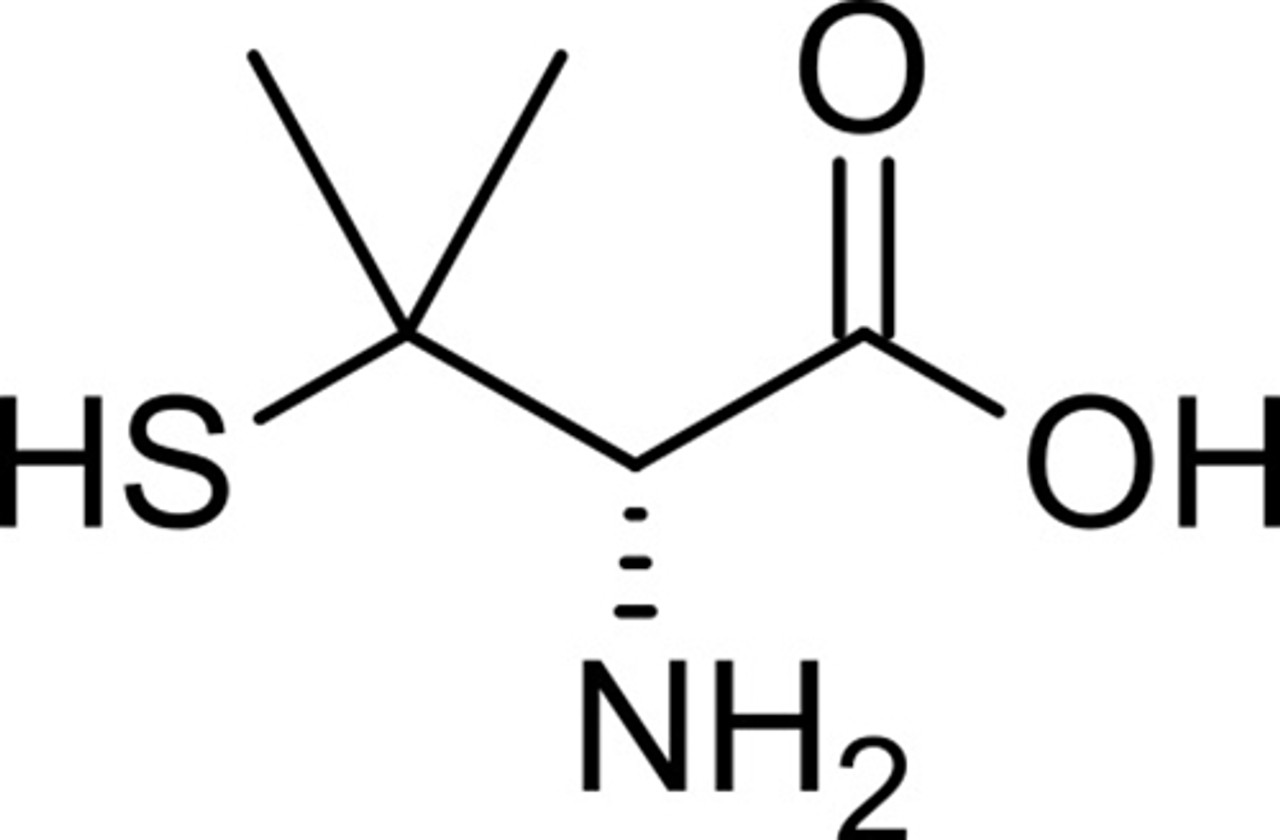
D-Penicillamine is a metabolite of penicillin but it does not have antibiotic properties. It is a copper chelating agent that also functions as a disease-modifying, anti-rheumatic immunosuppressant, and agent for cystinuria research and diagnostics. The compound is an amino acid that is structurally similar to cysteine. D-Penicillamine can also be used to study Wilson's disease, a disease characterized by excess copper in the body. Its use for this application was first described by John Walshe in 1956.
Penicillamine is chiral molecule which means it has two enantiomers: D-Penicillamine having (–) optical rotation, is the natural form whereas L-Penicillamine (having (+) optical rotation) is toxic to humans due to its inhibition of pyrodoxine. They have similar copper chelating ability.
We also offer:
- L-Penicillamine (P112)
| Mechanism of Action |
D-Penicillamine activity for cystinuria is via disulfide exchange between d-penicillamine and cystine, the product of penicillamine-cysteine disulfide being much more soluble than cystine. Penicillamine can inhibit the number of T-lymphocytes, inhibit macrophage function, decrease IL-1, decrease rheumatoid factor, and prevent cross-linkage of collagen. |
| References |
Purkiss P and Watts RW (1977) Low dose D-penicillamine in Cystinuria. Proc. Royal Soc. of Med. 70(3): 27-30 Walshe JM (1956) Wilson's disease; new oral therapy. Lancet. 270(6906):25-26 PMID 13279157 Drummer OH et al (1986) Measurement of Penicillamine and N-acetylcysteine in human blood by high-performance liquid chromatography and electrochemical detection. J Chromatogr. 374(2):251-257 PMID 3958085 |


