
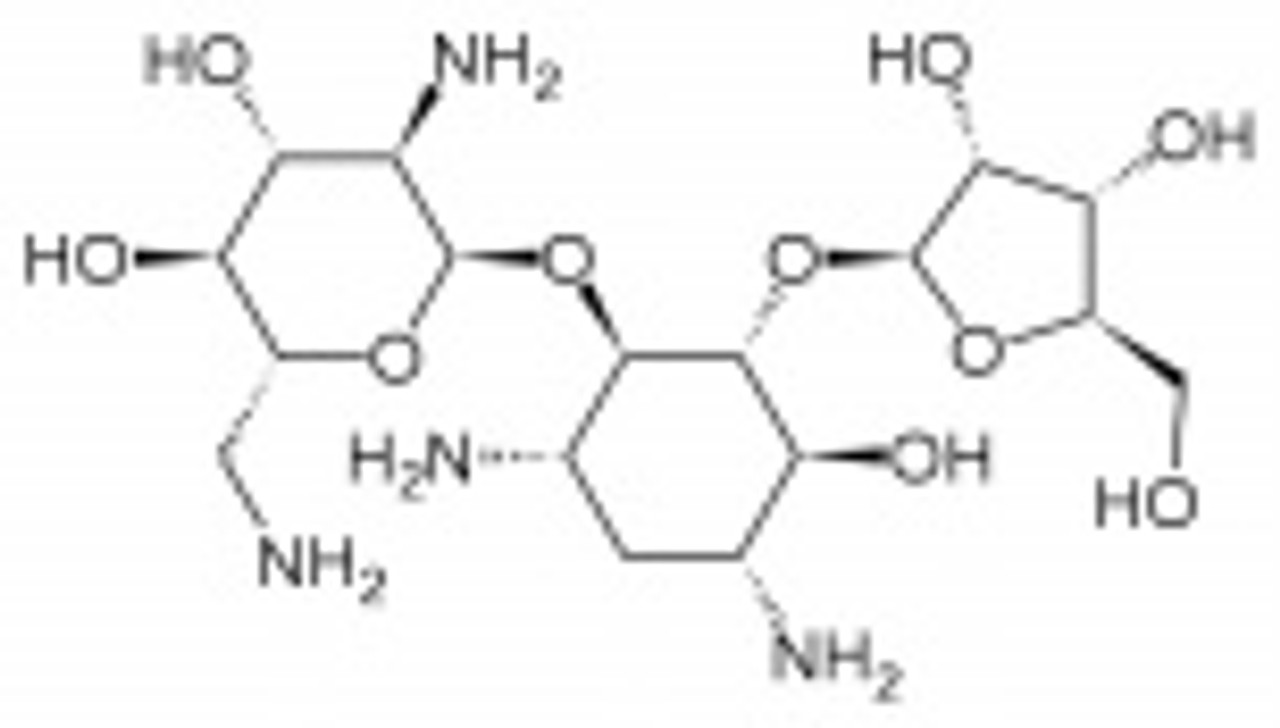
Ribostamycin Sulfate is an aminoglycoside-aminocyclitol antibiotic isolated from Streptomyces ribosidificus, originally from a soil sample in Japan. It is an important broad-spectrum antibiotic with bactericidal activity against Gram-positive bacteria and Gram-negative bacteria. The compound is used in studying human immunodeficiency virus (HIV) and it is also used in pharmacokinetic studies and studies of bacterial infection.
Ribostamycin Sulfate is freely soluble in aqueous solution.
| Mechanism of Action | Aminoglycosides target the 30S and 16S ribosomal subunit resulting in an inability to read mRNA ultimately producing a faulty or nonexistent protein. Ultimately it disrupts th integrity of the bacterial cell membrane, causing a membrane pore to form, which leads to bacterial death. Ribostamycin also inhibits protein disulfide isomerase (PDI). |
| Microbiology Applications | Ribostamycin resistance is due to bacterial enzymes that modify the structure through phosphorylation, adenylation, and acetylation and prevent the antibiotic from being able to interact with the bacterial rRNAs. |
| Spectrum | Ribostamycin is a broad-spectrum antibiotic targeting a wide range of Gram-positive and Gram- negative bacteria. |
| Molecular Formula | C17H34N4O10 · H2SO4 |
| References |
Davis BD (1987) Mechanism of bactericidal action of Aminoglycosides. Microbiol. Rev. 51.3:341-50. |
| MIC | Borrelia burgdorferi S.L.| 8 - 64|| Escherichia coli| 8 - 12.5|| |