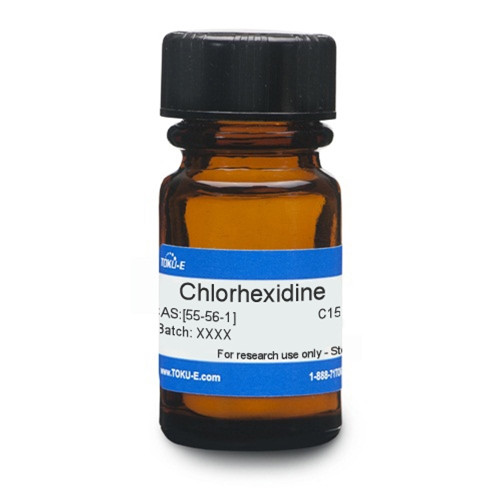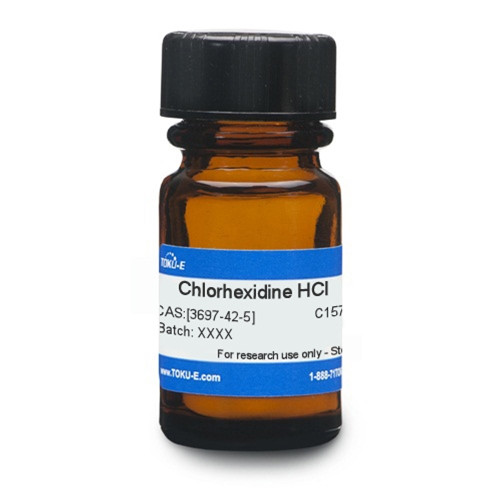


Chlorhexidine Diacetate is an antibacterial agent commonly used as a disinfectant. It is also used in dental research applications to study dental plaque.
This product is considered a dangerous good. Quantities above 1 g may be subject to additional shipping fees. Please contact us for specific questions.
We also offer:
- Chlorhexidine (C156)
| Mechanism of Action |
Chlorhexidine Diacetate is a cationic molecule which interacts with and alters the negatively charged bacterial cell wall. This interaction leads to leakage of cellular components at low concentrations and cellular lysis at higher concentrations. Membrane disruption, and not ATPase inactivation, is considered the lethal event in chlorhexidine action (ref). |
| Eukaryotic Cell Culture Applications |
Genotoxicity of chlorhexidine digluconate in rat peripheral blood and oral mucosal cells via the single cell gel (comet) assay and micronucleus assay was conducted. DNA damage was significantly increased in leukocytes and oral mucosal cells of the treated group seen by the comet assay. However, no micronucleated cells were detected in reticulocytes from peripheral blood cells. Researchers concluded that chlorhexidine digluconate can induce primary DNA damage in leukocytes and in oral mucosal cells, but no chromosome breakage or loss in erythrocytes occurred (Ribeiro et al, 2004). |
| Spectrum | Chlorhexidine Diacetate has a broad spectrum of activity and is active against Gram-positive and Gram-negative bacteria, yeasts and some viruses. |
| Impurity Profile | Impurities: Not more than 2.5% Chloroaniline: Not more than 500ppm |
| Molecular Formula | C22H30Cl2N10•2C2H4O2 |
| References |
Jones CG (1997) Chlorhexidine: Is it still the gold standard. Periodontol. 15:55-62 Kuyyakanond T and Quesnel LB (1992) The mechanism of action of Chlorhexidine, FEMS Microbiology Letters, Volume 100 (Issue 1-3):211–215 Moshrefi A (2002) Chlorhexidine. J West Soc Periodontol Periodontal Abstr. 2002;50(1):5-9. PMID 12049062 Ribeiro DA, Bazo AP, da Silva Franchi CA, Marques ME, Salvadori DM (2004) Chlorhexidine induces DNA damage in rat peripheral leukocytes and oral mucosal cells. J. Periodontal Res. 39(5):358-361 PMID 15324357 |