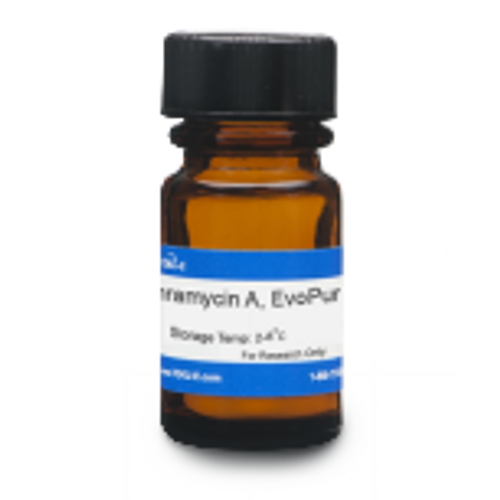


Enramycin is a polypeptide antibiotic produced by Streptomyces fungicidus. Enramycin is composed of two different compounds: Enramycin A and Enramycin B. The ratio of A and B varies but is typically ~70:30. Enramycin is slightly soluble in water.
We also offer:
| Mechanism of Action | Enramycin acts as a MurG inhibitor involved in peptidoglycan synthesis in Gram-positive bacteria. MurG catalyzes the transglycosylation reaction in the final step of peptidoglycan biosynthesis. Inhibition of this step greatly compromises cell wall integrity leading to cell lysis. |
| Spectrum | Enramycin has strong antibacterial activity against Gram-positive bacteria including methicillin-resistant Staphylococcus aureus (MRSA) and inhibits the development of major gut flora pathogens. Resistance or cross-resistance with existing antibiotics has rarely been observed. |
| Molecular Formula | Enramycin A: C107H138Cl2N26O31 Enramycin B: C108H140Cl2N26O31 |
| Solubility | Acids (Dilute HCl): Freely soluble Dimethylformamide: Freely soluble Water: Slightly soluble |
| Microbiology Applications |
Enramycin is commonly used in clinical in vitro microbiological antimicrobial susceptibility tests (panels, discs, and MIC strips) against Gram-positive microbial isolates. Medical microbiologists use this information to recommend antibiotic treatment options. |
| References | Fang X et al (2006) The mechanism of action of Ramoplanin and enduracidin. Royal Soc. Chem. 2: 69-76 PMID 16880924 |
| MIC | Clostridium perfringins| 0.05 - 1.6|| Staphylococcus aureus| 0.013 - 0.413|| |